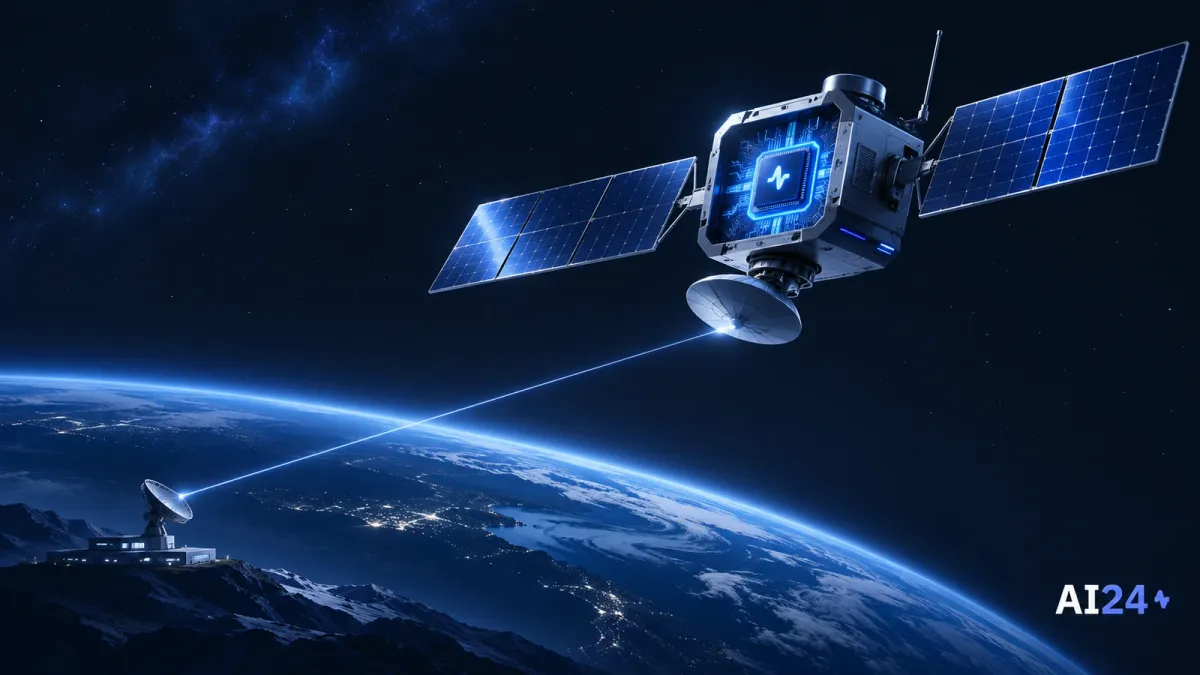
Google said on October 30 that it had received the first AI response from its Project Suncatcher prototype satellite. According to the company, Gemma 4 running on an orbiting TPU answered a request for a haiku about space. The reply reached Earth during a pass over Svalbard, Norway, as part of research into computing beyond the planet.
The result is limited but clear: the system powered up in orbit, received a request and ran a model that returned an answer. It does not yet establish that a space-based data centre can operate reliably over time, serve customers or compete with terrestrial costs. Google calls this long-term research; the next tests address the distance between a first response and dependable infrastructure.
From launch to the first poem
The prototype launched on October 1. Google said it was built with Planet and carried on SpaceX's Transporter-18 mission, and reported successful contact. In the following weeks, the team completed commissioning checks, powered the host computer and TPU trays, and ran initial machine-learning tests.
The October 30 update describes uploading the prompt while the satellite was within range of a ground station. Gemma 4 produced a short poem. Subsequent tests included space-themed limericks and telemetry prompts about the payload systems' technical status. These activities are described in Google's account of its own experiment.
Requesting a poem serves a simple purpose: demonstrating that the communication and computation chain works end to end. The poem is not a measure of model quality, and the announcement offers no comparative benchmark against a ground-based server. Nor does it describe training a new model in space. Running an existing model to produce an answer is inference.
That distinction limits what can be inferred. Powering a chip, running a model and receiving output are different milestones from operating a large accelerator cluster. Infrastructure would require repeating the process reliably under changing conditions and linking compute and communication systems. The present experiment starts testing that path in practice.
Why investigate computing in space?
Project Suncatcher was introduced in November 2025. Google described a network of solar-powered satellites carrying TPUs and connected by optical links. The research asks whether that architecture could scale machine-learning computation. The original announcement supplies background; the response from orbit is the new development.
Google's research explains that a suitable orbit could provide almost continuous sunlight and reduce the need for heavy batteries. Energy collection is only part of computer-system design, however. Data must reach the right place, heat must dissipate and hardware must keep working. Orbit changes how those requirements are addressed rather than removing them.
A TPU is Google's accelerator for machine-learning workloads. Here the question is not only what the chip computes, but how it behaves outside a conventional data-centre environment. Radiation, temperature changes and communication constraints matter. One successful output does not provide the same evidence as continuous operation over time.
Google published ground-based radiation experiments and satellite-system analysis in 2025. Those helped inform the design, but ground tests and flight conditions differ. Launching allows evidence to be collected in the relevant environment. An experiment with modest output can therefore provide useful information about operating the hardware in orbit.
Linking satellites is a separate test
Google plans two interconnected satellites in 2027. The latest update presents this as the next milestone, not a public cloud-service launch date. Interconnection matters because large AI systems depend on many accelerators working together. Running a model on one unit does not automatically demonstrate distributing work across separate units.
The company's design research says inter-satellite links need high bandwidth and low latency to approach terrestrial data-centre operation. It examines optical communication and formations that keep satellites relatively close. These are engineering requirements for a proposed design, not a description of a commercial orbital network already operating.
Close formations also raise orbital-control questions. A distributed system must exchange information, maintain connections and respect each satellite's movement constraints. Google has presented models of those dynamics, but the latest announcement does not say every difficulty has been solved. It adds a practical result about computation aboard the satellite itself.
Ground connectivity remains part of the system. In this experiment, the prompt and output travelled during a ground-station pass. A continuous service would require broader assessment of connection availability and transfers to and from users. The poem establishes no fixed response time, request capacity or customer service level.
What remains after the first answer
Google says upcoming tests will examine TPU performance under orbital thermal stress and radiation exposure. The question moves from whether the system works to how it works in difficult, sustained conditions. Reliability, fault handling and heat management matter alongside producing valid output. Those tests will inform the next mission.
Economic viability is separate again. Google's original research considered future launch costs, but projections are not a current service price list. The new update provides no customer pricing or commercial availability date. For AI users and organisations, it is progress towards possible infrastructure, not a new destination for production workloads or cloud budgets.
The poem received over Svalbard is not the product. It signals that the experiment can now ask harder questions of the same hardware: how long it operates, under what conditions and how it connects with another satellite. Good answers would support the next design steps. The announcement records this first step without shortening the road ahead.