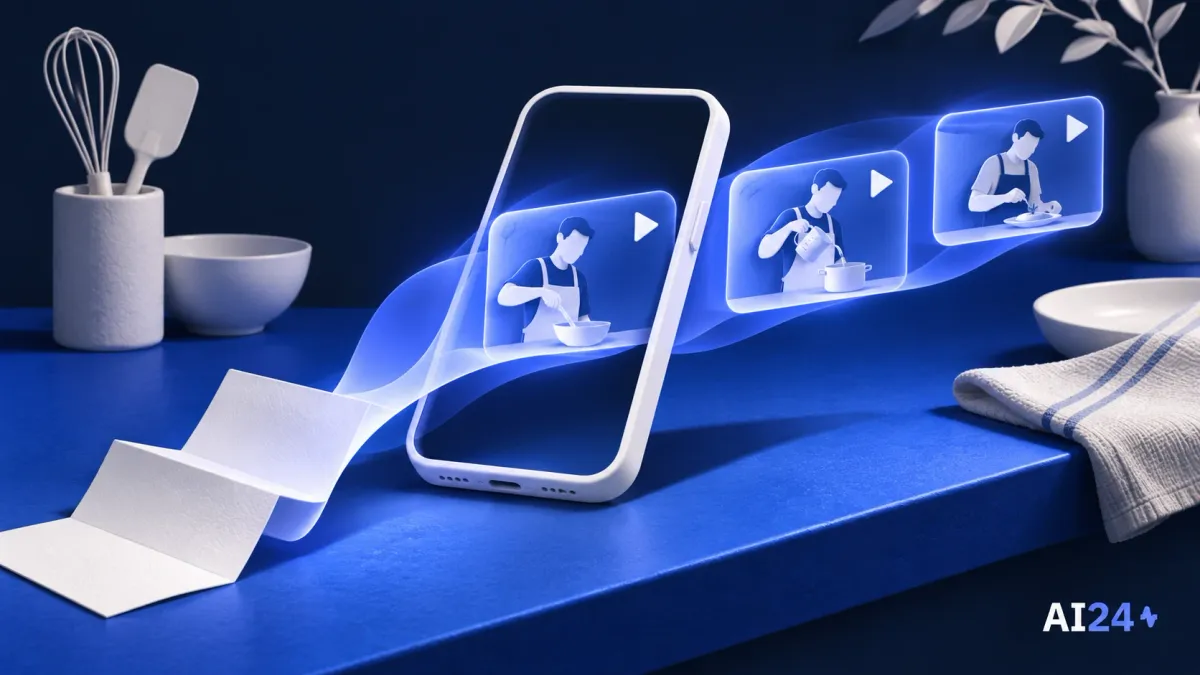
Bites announced a $40 million Series A on October 29, 2026, led by PeakSpan Capital. The company, which develops AI training tools for employees who do not work at a computer, has raised $55 million in total. Existing investors Vertex Ventures, Horizon Capital, Rittenhouse Ventures and Lyra Ventures also participated, according to reports of the transaction.
Bites has a development center in Tel Aviv and its headquarters in New York. Its product takes a procedure, document or idea and turns it into a short training video delivered to an employee's phone. The premise is that training should reach the place where work happens, in a language the worker understands and through a familiar channel, without requiring a separate system.
From Tel Aviv restaurants to a training platform
Bites was founded in 2020 by Eran Hefetz, Tal Nagler-Almog and Hagai Horowitz. Hefetz, the CEO, previously co-owned several Tel Aviv restaurants, including Vicky Cristina, Bread Story and Little Italy. Nagler-Almog, the COO, previously ran the psychometric exam-preparation department at Kidum. Horowitz, the CIO, is an electrical and computer engineering graduate who also worked at Kidum.
The founders' backgrounds bring together daily service operations and learning processes. Hefetz's perspective comes from a business where employees do not spend their shifts at a computer. That is also the audience the company puts at the center of its product: people who need to receive and use instructions while working in the field, in a shop, in a restaurant or on a shift.
In Ynetnews' report, Hefetz cited a figure of about 80% of the global workforce, roughly 2.8 billion people, working away from a computer desk. That is his stated rationale for the product. It does not mean all those workers are potential Bites customers or that the company already reaches them; it explains its approach to training.
Content tailored to the business, delivery to the phone
According to the product description, Bites turns raw material such as a document or an explanation of a procedure into a branded video within minutes. Customization can include the client's branding, locations, uniforms and products. The stated aim is to make the training reflect the worker's relevant environment rather than rely on a generic video detached from the business.
Delivery follows production. Videos reach phones through WhatsApp or Microsoft Teams in the worker's language, with no app installation or new login required, according to the company. This separates creating training material from actually getting it to employees. A quickly produced video has little practical value if a worker cannot open it through a channel they use.
For a manager, connecting these stages may be particularly useful when a procedure changes: prepare material that fits the business, then send it through a familiar channel. That is an example of a possible use of the described product, not a measured time saving at a particular customer. Fast production and phone access are not, by themselves, evidence that instructions were understood or correctly applied.
The company describes delivery in the employee's language, but this does not specify translation quality for every language or linguistic coverage in every work setting. In actual training, the wording an employee receives matters as much as the design. Even a video showing the correct uniform and product must accurately preserve the original instruction, especially when a small wording change could alter the task.
From employee questions to performance measurement
Alongside videos, the platform includes an Ask-AI chat feature and a knowledge base for work-related questions. The company describes these as ways for employees to ask a specific question instead of relying only on pre-prepared training. Together, they offer two modes of use: proactive instruction from the organization and access to information when a need arises during work.
Bites also describes integrations with customers' sales, CRM and HR systems to identify performance gaps by branch, shift or individual and generate targeted follow-up training. The company is developing this capability further. Its direction and described functionality should therefore be distinguished from evidence that automated training has already improved a particular business outcome.
The distinction matters because watching a video and achieving a result at work are different measures. The approach Bites describes seeks to connect training content to the point where improvement is needed. It does not, by itself, explain the cause of every performance gap. Even when data is associated with a shift or branch, managers still need to understand what it measures and how it informs the next training decision.
Named customers include Unilever, Shake Shack, Coca-Cola and Electra. The list indicates the kinds of organizations Bites serves, but does not specify how many employees use the product at each or which components they use. It is a list of identified clients, not evidence that every described capability operates at the same scale across all of them.
Repeated employee questions may also point to wording that needs clarification. That can give a manager a reason to revisit the original material rather than rely solely on the availability of chat answers.
Where the funding is intended to go
Bites employs about 30 people. Its plan is to use the funding to expand the Israeli development center and AI engine, while growing sales and customer-support teams. It also plans a partner and distributor network and a larger U.S. operation. The round therefore supports both the product and the capacity to implement and support it for customers.
Planned areas of expansion include banking, insurance and organizations with large external or contract workforces. These are future business targets, not announcements of new agreements in every sector. Their common need is to deliver knowledge to people receiving instructions as part of their work, even when they are not office employees gathered around one system.
The Israeli connection is clear: the founding team and the Tel Aviv development center, which Bites plans to expand. At product level, the central question is more practical than the funding total: how does a management document become an instruction a worker can understand and use? Bites proposes connecting video creation, distribution and follow-up questions; the link to performance is the next part it aims to develop.